




Imagine this: you’ve spotted a promising futures setup, price is moving fast, and you’re a minute away from either capturing a profitable squeeze or missing your edge. You reach for your phone, tap the OKX app, and—something goes wrong at login. It’s a small action in normal times, but for a trader it’s an operational choke point that can turn strategy into regret. This piece walks through how OKX login works at a technical and procedural level, corrects common misconceptions, explains trade-offs for U.S.-based traders, and leaves you with a toolbox of practical checks and decisions you can reuse.
We’ll cover three things: the mechanism behind account access and protections (what really happens when you log in), where that mechanism breaks or introduces risk (and why delisted pairs or high leverage matter), and simple heuristics to decide when to use the custodial exchange vs. your non-custodial wallet. The goal is not cheerleading but to replace vague anxieties—“Is my account safe?” or “Will I be locked out?”—with clear models you can act on during a trade window.
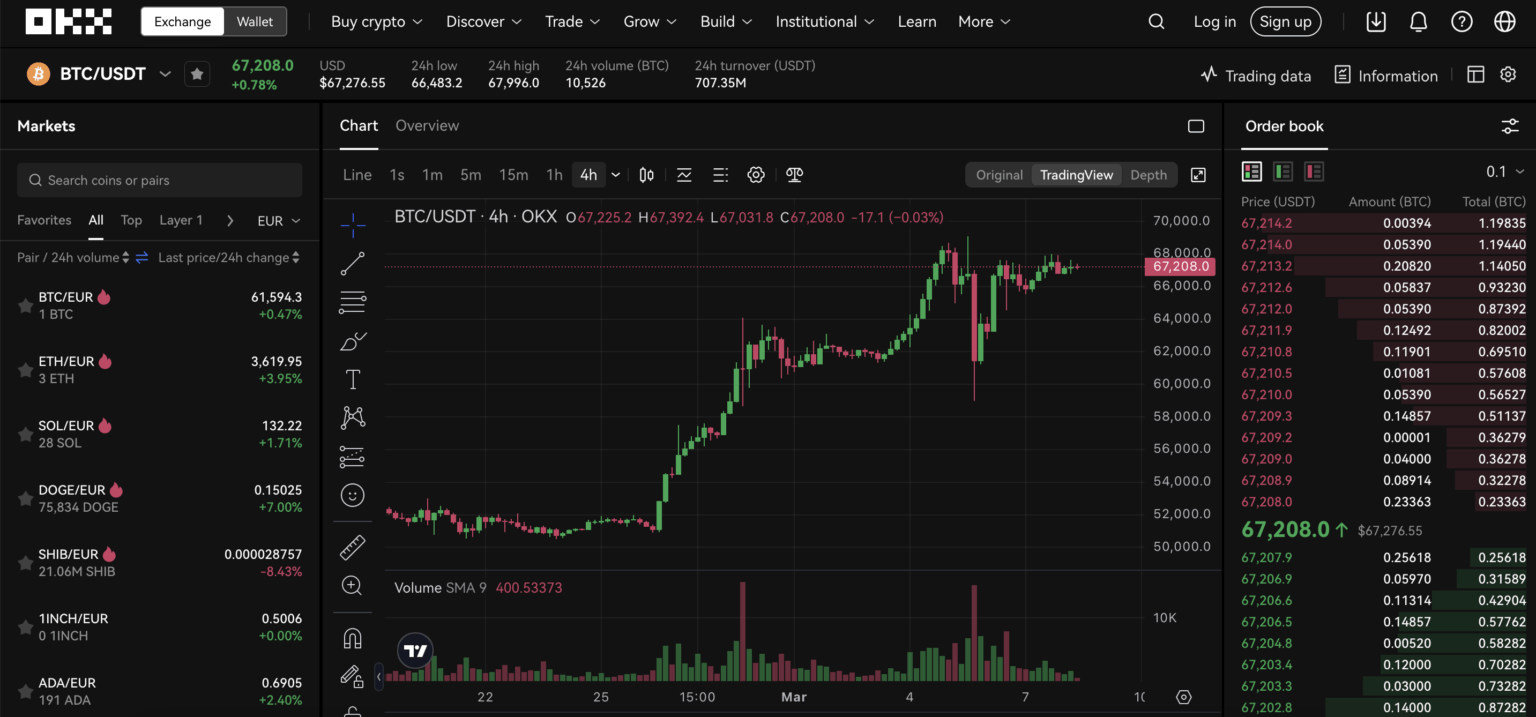
At a mechanistic level, OKX uses a layered approach: identity verification (KYC) ties a person to an account; a credential layer (username/password) handles authentication; and a device/session layer plus 2FA enforces ongoing access control. For U.S. users, the KYC step is non-negotiable—law and platform policy require a government ID and facial liveness check during account creation. Once the account exists, mandatory two-factor authentication is enforced via SMS, Google Authenticator, or biometrics on mobile. There’s also AI-driven real-time threat detection that flags suspicious login patterns and applies extra friction or temporary blocks.
Putting it in a literal sequence: you submit credentials → the server validates those credentials and the session token → 2FA challenge is issued and validated → device/session metadata is recorded and monitored for anomaly. If an anomaly appears—unusual IP, new device, or rapid multi-region logins—the AI layer can interpose additional checks or even freeze withdrawals until manual review. These are the automated safety valves that try to prevent remote compromise while allowing legitimate traders to move quickly.
Misconception 1: “If the exchange is hacked, my funds are automatically gone.” Correction: OKX stores over 95% of assets in air-gapped cold wallets using multi-signature controls. That reduces systemic theft risk compared with keeping funds hot. However, cold storage doesn’t protect account-level privileges: compromised credentials or social-engineered support access could still allow an attacker to drain funds from the small share that remains hot for liquidity or to execute trades. So cold storage lowers but does not eliminate operational risk.
Misconception 2: “2FA makes me immune to phishing.” Correction: Two-factor authentication significantly raises the bar, but it can be bypassed by well-orchestrated phishing (credential + 2FA prompt interception) or SIM-swapping attacks targeting SMS-based 2FA. For this reason, using app-based authenticators or biometric login on your device and protecting the recovery channels (email, phone) matters more than the mere presence of 2FA.
Misconception 3: “I should always keep everything on the exchange for speed.” Correction: There’s a trade-off between custody and velocity. Keeping assets on OKX enables fast entry/exit, access to high-leverage futures (up to 125x for some products), and staking/yield features. But the trade-off is exposure to centralized risks (platform outages, KYC disputes, or withdrawal freezes). For scalpers or day traders who must enter and exit within minutes, keeping a working balance on the exchange makes sense; for strategic holdings, non-custodial wallets or hardware devices are safer.
Routine platform changes—like the recent delisting of multiple spot trading pairs this week—show how the exchange continuously prunes markets to maintain liquidity health. If you depend on a delisted pair, you might suddenly need to move positions or convert to an alternate market. That’s a liquidity and execution problem, not a login problem, but it becomes a login problem if you can’t get into your account to act. In practice, fast-moving traders should plan for both technical and market contingencies: maintain a small operational balance for emergencies, set chained exit orders where possible, and use alerts independent of a single device or channel.
Operational failures can be caused by: 1) forgotten or rotated 2FA devices, 2) account recovery delays due to KYC review, 3) device-level biometric failures after OS updates, or 4) protective freezes triggered by AI threat detectors. The right mental model is to treat login failure as a system failure with multiple causes: credential, device, identity, or platform policy. Each requires a different remedy and different lead time to fix.
Here’s a simple decision heuristic that I find helps traders choose when to use the exchange vs. non-custodial routes:
– If your strategy is latency-sensitive (scalping, short-term futures where slippage kills the edge): keep a calibrated working balance on OKX, enable app-based 2FA and biometrics, and maintain a hot device dedicated to trading. Expect and accept some centralization risk in exchange for execution speed.
– If your objective is capital preservation (long-term holdings, staking, or NFT custody): favor the non-custodial Web3 wallet with hardware wallet integration. That protects private keys and reduces dependence on exchange login flows, but it increases responsibility (seed phrase safety) and makes rapid execution harder.
– If you trade both ways: segregate funds. Maintain a small, managed trading float on OKX for active positions and keep the majority in cold storage or a hardware-backed wallet. Replenish the float through scheduled transfers rather than last-minute top-ups.
Before a trading session, verify these items in order:
1) KYC and recovery: confirm your identity documents and recovery email/phone are current; check for any pending verification flags. KYC delays can take days to resolve and are an operational bottleneck.
2) 2FA hygiene: prefer app-based authenticators over SMS; keep a secure backup of seed keys for the authenticator in a separate safe location. For biometrics, test after OS updates.
For more information, visit okx login.
3) Device and network: whitelist trusted devices where the exchange allows it, and avoid public Wi‑Fi for trades. If you use VPNs, choose a single consistent exit region to avoid triggering fraud detectors.
4) Withdrawal settings: set withdrawal address whitelists and small daily limits to reduce damage from potential compromise. This adds friction for attackers while keeping your ability to trade intact.
5) Practice recovery: run a dry run of account recovery steps when you have time, so when something goes wrong you’re not learning under pressure.
No system is perfect. The main unresolved tensions are between rapid access and fraud prevention: stronger automated locks reduce theft but increase false positives that impede legitimate traders. AI threat detection improves with data but also risks over-fitting to normal behavior patterns; changes in your behavior (travel, new device) can be misread. Watch for signs that platform policies or the regulatory climate in the U.S. are tightening KYC/review timelines—those are the levers that add friction to recovery and withdrawals.
Another open question is how OKX balances expansion of derivatives (like high-leverage futures) with liquidity safety. Perpetuals with up to 125x leverage are powerful but amplify market and counterparty shocks; delistings and liquidity pruning are part of the exchange’s response, but they can create execution friction. For traders, the practical implication is to institutionalize contingency plans rather than rely on the ideal case where login and markets are both available simultaneously.
– Platform announcements about KYC processing changes or additional authentication options. These alter how long recoveries take.
– Liquidity and delisting notices (like the recent routine delistings). If your instruments get pruned, you need exit pathways pre-arranged.
– Changes in 2FA options or hardware wallet integrations—improved hardware support reduces phishing risk but can add setup complexity.
A: Use an authenticator app or biometric login where possible. SMS is convenient but vulnerable to SIM-swap attacks. If you must use SMS, pair it with other safeguards: withdrawal whitelists, low daily limits, and a separate recovery email secured with a strong password and its own 2FA.
A: Recovery time is variable and depends on KYC status and the exchange’s verification queue. Plan for hours to days in routine cases; it can take longer during high-volume market events. That uncertainty is why you should maintain a small operational balance on the exchange for urgent trading needs.
A: A non-custodial wallet shifts the trust boundary: you control the private key (and therefore access), not OKX. Login becomes a local cryptographic operation rather than a centralized authentication flow. This reduces dependency on exchange KYC and support, but you assume full responsibility for seed phrase security—losing it usually means permanent loss.
A: Safety here is about understanding exposure, not absolute risk-free guarantees. OKX provides tools (insurance funds, liquidations engines), but high leverage amplifies market and liquidity risks. Ensure you understand maintenance margin mechanics, have pre-funded buffers to avoid liquidation in volatile moves, and accept that platform rules and delistings can change available markets.
Two practical final heuristics: first, treat login as a trading resource that must be prepared like capital or data feed reliability; second, separate custody decisions from execution needs. If you do these two things—manage your trading float and harden authentication—you reduce the chance that a login hiccup turns into a trading disaster.
For a concise guide to the OKX login page and step-by-step tips on access, see this quick reference on okx login.

hãy để chúng tôi giúp bạn!
(+84)911 200 100
